

By Ragini Nikumbh, Cement Technical Services Engineer, Heidelberg Materials North America
Not every project will require ultra-high performance concrete (UHPC). But where load demands are high, maintenance access is limited or exposure conditions are severe, UHPC delivers exceptional performance.
The value of UHPC begins with its structural capacity. With compressive strengths ranging from 150 to more than 200 MPa—often 5 to 10 times stronger than traditional concrete—UHPC fundamentally changes what designers can do with a cross-section. This enables engineers to specify dramatically slimmer columns, thinner bridge decks and narrower support beams, all while maintaining or exceeding required load capacity. Less material carries the same load, which reduces dead weight, opens design options and frees up space that heavier sections would otherwise consume.
Vertical construction
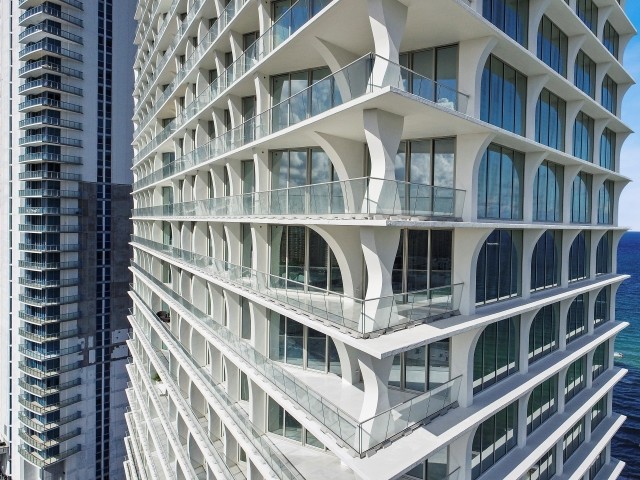
In vertical construction, such as for architectural and high-rise construction, weight is a constant constraint. Ultra-thin facades made from UHPC reduce a building's dead weight, easing demands on the structural frame and foundation. Slender structural elements maximize usable floor area, a meaningful advantage when leasable space drives project economics. The material also enables self-supporting roof systems that span without the bulk conventional concrete would require. Across all these applications, the high durability of UHPC reduces long-term upkeep on elements that are difficult and expensive to access once a building is occupied.
Bridges
Bridges expose concrete to a punishing combination of heavy cyclic loading, de-icing salts and extreme weather. UHPC is well suited to each of these challenges. Its compressive strength, fiber-reinforced crack resistance and near-zero permeability allow engineers to build lighter, longer-lasting structures that resist chloride-driven corrosion and seasonal stress.
UHPC provides special value in several bridge applications:
Overlays applied to the pavement surface, which extend deck life.
Bridge joints, where UHPC’s durability and crack resistance address a common failure point.
Repair work that restores capacity to aging structures.
Abutment connections between the bridge and its supports, where reliable load transfer is critical.
Marine and coastal structures
Few environments degrade concrete faster than saltwater exposure, so marine and coastal structures often benefit from the use of UHPC. Chloride ingress, wet-dry cycling and constant moisture attack both the matrix and any embedded reinforcement. UHPC’s dense matrix dramatically reduces inward pathways for these aggressive agents, making it a good fit for high-durability seawalls, corrosion-resistant pilings and offshore structures. These are also settings where inspection and repair are costly and disruptive, so durability carries particular importance.
Security, defense, and heavy industry
UHPC is especially valuable where structures must absorb severe, concentrated forces. Its ductility and energy dissipation make it effective for demanding applications in security, defense and heavy industry applications, such as:
Blast and ballistic mitigation, where the fiber-reinforced matrix absorbs massive dynamic energy and resists fragmentation.
Industrial wear flooring, where impact resistance stands up to heavy machinery and sustained abrasion.
Subway and utility tunnels, where the material withstands high hydrostatic and geological pressure.
Cost considerations and best practices
The premium constituents that give UHPC its properties also raise its material cost. These costs can be mitigated, however, by following best practices during material selection, mixing and placement.
Tailoring mixes to specific performance targets is one method of cost-reduction. Attention to details like packaging and sourcing are also important. Pre-blended packaging offers the advantage of precise particle packing and factory quality control. For UHPC, the cost advantages associated with locally sourced raw material can be erased by the rigorous testing needed to ensure material consistency and grading stability.
Following best practices in the field also leads to the best outcomes and the strongest return on investment. Sound results start with proper mixing, such as adopting strict sequencing rules to achieve optimal fluid workability and taking care to distribute fibers evenly throughout the matrix. Placement technique is equally important. Crews should use watertight formwork with sealed joints to prevent matrix leakage. Avoiding admixture overdosage and controlling drop heights improve self-consolidating flow and prevent segregation.
Curing and workforce factors round out the requirements. Proper curing is critical for developing the desired microstructure. Low-tolerance casting calls for a certified workforce and trained personnel, and the rigorous specifications of UHPC demand precise logistical timelines and careful planning.
The strongest argument for UHPC often emerges only when the full service life is considered. Over the life of a structure, UHPC delivers near-zero maintenance, lower operational downtime and extended lifespan. It also requires less material overall, since its strength allows thinner, lighter sections. For owners weighing whole-life cost rather than first cost, those advantages frequently reshape the economics in UHPC's favor.
If you have a project where load demands are high, exposure conditions are severe or long-term access is limited, now is the time to evaluate whether UHPC belongs in your design. Connect with the UHPC experts at Heidelberg Materials to review your specifications, weigh whole-life cost against first cost and determine how UHPC can deliver lasting value on your next structure.