
The biggest challenge in sustainable construction is not interest. It is confidence and execution.
Many project teams now face aggressive sustainability goals, tighter specifications and high expectations from owners and communities. Contractors, engineers, developers and project stakeholders are being tasked with using innovative materials and new material combinations to reduce embodied carbon. Heidelberg Materials has the technical expertise to deliver novel concrete mixes for real construction conditions, where schedules are fixed and crews need predictable workability.
We are focused on closing the confidence gap and delivering real world solutions. Across global markets, we are advancing lower-carbon concrete that moves beyond theory where performance matters most: active jobsites.
The material science behind lower embodied carbon
Heidelberg Materials knows innovative mixes must be engineered into complete concrete systems. Cement types, supplementary cementitious materials, aggregate proportions, water demand, batching sequence and field handling all influence concrete performance and place-ability. We work with our customers to address these variables—enabling project teams to meet carbon reduction goals with confidence. We work with our customers from the mix design stage, through production planning, plant coordination, to delivery and placement.
From sustainability ambition to field confidence
Trial mixes and pilot pours help qualify novel materials and answer key performance questions:
Will it help meet environmental goals without affecting durability or structural performance?
Are there special material handling requirements so it batches and can be delivered consistently?
Will it place, consolidate and finish in a familiar way?
Will it support safe and efficient field operations?
Case Study
In spring 2026, Heidelberg Materials collaborated with a customer to develop and test trial concrete mixtures with a new cement type for a project south of Atlanta, Georgia. The pilot program evaluated concrete performance throughout the production process, including mixing, batching, delivery, placement, and finishing.
Testing
Trial mixes were tested in our regional laboratory to confirm mix performance and pre-qualify the new material before field use. Prior to supplying the project, truckload quantity trial mixes were batched to ensure trouble-free delivery of the innovative mixes to our customer.
Trial mixes and batching
Concrete production was done at Heidelberg Materials’ Jenkinsburg, Georgia, batch plant. Since the project required the use of novel materials sourced in bulk bags, concrete load sizes were tailored to use increments of full bulk bags. Special handling and safety procedures were established to ensure safe efficient batching of all mix components.
Concrete delivery and finishing
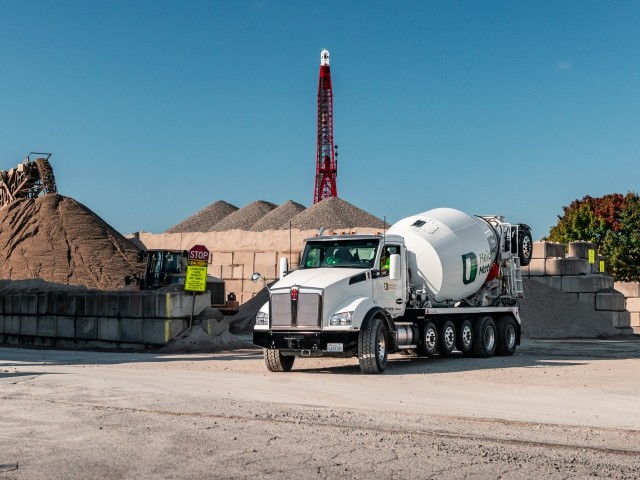
When concrete mixers delivered the lower-carbon concrete to the testing location, teams monitored placement, striking-off and consolidation efforts, confirming that for the text mix and conditions, the concrete’s behavior was typical of traditional mixes.
The onsite concrete contractor troweled and then applied a broom finish about two and a half hours after concrete reached the job, commenting that the mixes finished well and placement operations went smoothly.
The results of the Jenkinsburg pilot pour demonstrated that lower-carbon concrete can support sustainability goals while meeting familiar constructability expectations. Beyond the test results, the pilot pour process itself was important, as it highlighted critical steps in taking technology-ready concepts and successfully implementing them in the field.
The process also shows that when project owners, construction teams and materials partners work together, innovative concrete mixes can be confidently placed, an important step in bringing novel materials to market. Heidelberg Materials brings the global reach, technical expertise and field discipline needed to help its customers build the future with assurance.
Click here to read the complete case study.