

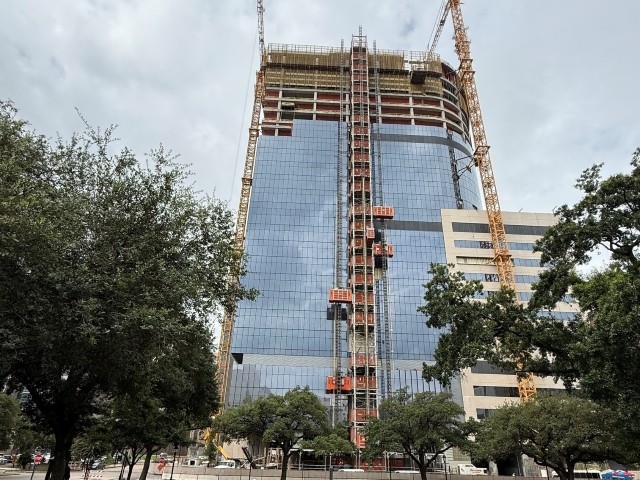
Houston Methodist, one of the nation’s leading health care systems, is reshaping its flagship campus at the Texas Medical Center in Houston with the addition of the Brockman Centennial Tower. At a cost of about $1.4 billion, the tower will modernize aging portions of the campus while expanding capacity to meet rising patient demand. The project provides an example of how solving complex structural problems can have effects that reach beyond the design itself, even supporting better clinical care.
The 26-story tower will include more than 1 million square feet of space and feature nearly 400 patient beds, expanded emergency and imaging services, new operating rooms with advanced surgical capabilities, and a landscaped rooftop garden for patients, visitors and staff. Construction began in 2022, and a phased opening is expected to begin in 2027.
Heidelberg Materials supplied all concrete for the project’s superstructure.
The Challenge of an Open Corner
One project requirement was keeping the tower's northwest corner free of ground-level columns and foundations, so that emergency and other vehicular access could be preserved, and an existing underground utility could be accommodated without relocation. To meet this challenge, engineers at Walter P Moore designed an elevated transfer system. The key components of the system are:
- An 8,000-psi post-tensioned concrete transfer girder that is 27 feet deep with a 53-foot cantilevered portion.
- A 68-foot backspan, which balances the cantilevered load and reduces uplift.
- Roughly 300 post-tensioning tendons to control deflection and manage reinforcement congestion.
To preserve clearance above the ambulance drive, the team located the transfer girder on a mechanical floor several levels above grade rather than directly over the drive. The taller height of this story accommodated both the girder and the backspan. This placement introduced a challenge of its own, however: not only did the girder need to support column weights from the stories above it; it needed to have columns for the building’s first few levels suspended below it. This created temporary loading conditions that shifted as construction progressed, which the project team addressed through construction and stressing sequencing of single-stage tendons.
Heidelberg Materials supplied approximately 1,800 cubic yards of high strength, 8,000 psi EvoBuild™ Silver concrete mix for the transfer girder, which met several project objectives.
Concrete contained in the cantilever and backspan of the girder system qualified as a mass concrete pour, making heat of hydration a consideration. EvoBuild Silver’s low heat of hydration helped control temperature differentials within the girder as it cured, protecting against future cracking. The mix also delivers strength precisely where the structure needs it, carrying the concentrated loads that make the column-free corner possible. As a low-carbon product, it reduced embodied carbon compared with a conventional alternative, adding an environmental benefit to its structural performance. Keystone Structural Concrete supported successful placement of the mass concrete by creating mock-ups using the concrete mix prior to construction.
The Brockman Centennial Tower is more than a capacity expansion. It is a demonstration of how state-of-the-art materials and structural engineering approaches are accomplishing complex project goals—all while reducing carbon.
- Owner: Houston Methodist
- Architect: Page (now Stantec)
- Structural Engineer: Walter P Moore & Associates
- General Contractor: Vaughn Construction
- Concrete Supplier: Keystone Structural Concrete